Explaining Felt Contingency
Answering Kripke's Argument Against Type Theory

Introduction
Naming and Necessity is, I think, in contention for the greatest piece of analytic philosophy ever penned. I have other favorites of course (Problems of Philosophy gets a big shoutout) but it is hard to beat a book that proceeds from a refutation of the dominant theory in philosophy of language, to a rebuttal of the leading (or one of the leading) theories of physicalism. It’s also just really funny. The argument against physicalism delivered by Kripke in N&N is pretty influential, and sometimes gets conflated or compared to the Zombie argument against physicalism. I think that the Zombie comparison actually obfuscates Kripke’s point, though. His argument is substantively different. I take Kripke’s argument to be something like the following:
If (type) physicalism is true, there is a necessary identity between ‘pain’ mental states, and ‘C-fiber firings’ brain states.
The type physicalist takes this identity to be similar to that of ‘heat’ and ‘motion of molecules’.
The identity of ‘heat’ and ‘motion of molecules’ appear to be contingent, as does the identity between ‘pain’ and ‘C-fiber firing’.
But we have a good account of why there is this apparent contingency in the ‘heat’ and ‘motion of molecules’ case.
This account does not work in the case of ‘pain’ and ‘C-fiber firings.’
So the analogy between the cases breaks, and we have no good reason to question the apparent contingency of the ‘pain’ and ‘C-fiber firing’ identity.
But if that identity is contingent, then there is no such identity at all (see the first line of the argument).
So, there is no identity between ‘pain’ and ‘C-fiber firings.’
In the first section of this article, I’ll outline Kripke’s argument in more detail. In the second, I’ll propose a way that you can reject his claim that there is not a sufficient account to explain the apparent contingency of the ‘heat’ and ‘motion of molecules’ case that is able to likewise explain the apparent contingency of the identity between ‘pain’ and ‘C-fiber firings.’ The idea I propose is that, in both cases, our intuition of contingency is motivated by the apparent possibility of different things fulfilling the functional roles of the phenomena explained by these identities (heat and pain).
Type Physicalism
What view does Kripke take to be false? Kripke is arguing against type-type identity theory, or type physicalism, or type identity theory, or the identity theory, or… I’ll stop. People call this view all sorts of things. I’m just going to call it ‘type physicalism.’1 The type physicalist view is that we have two sorts of states, mental states like seeing red, being in pain, and the like, as well as brain states like C-fiber firings, or the stimulation of various neurons in the frontal lobe. The type physicalist thinks for each ‘type’ of the former, there is a ‘type’ of the later, for which an identity holds. Another way to think of it is that every mental property is identical with some physical property. The favored analogy of the identity theorist (as Kripke notes!) is with scientific identities. Heat is the motion of molecules is a favorite. The two phenomena are, in fact, the same thing. There is no mystery why something with fast moving molecules is warm, because for something to be warm just is for its molecules to be moving quickly. Much the same, so says the type theorist, with mentality. Once we realize that pain just is the firing of C-fibers, no more questions arise about why pain comes along for the ride when the C-fibers fire. They are one and the same thing! So what’s Kripke’s problem with the type theorist? Well…
Kripke Kicking (K)Ass
A couple technical preliminaries. Firstly, a ‘rigid designator’ is a term that refers to the same thing in every possible world. You might think, for instance, that when I use the name ‘Bob’ to refer to the guy who works at my closest seven eleven, and then use that same name to talk about a possible world wherein Bob fights off laser dinosaurs with a light saber, the name ‘Bob’ is referring to the same person in both cases. Indeed, that it would do so in all such cases. That this is, in fact, true of proper names is a substantive thesis (indeed, one Kripke argues for throughout all of N&N) but hopefully the concept of rigid designation is clear. Secondly is Kripke’s claim that terms like ‘heat,’ ‘pain,’ and others designate rigidly, despite not being names. This is, again, a substantive thesis that has to do with Kripke’s views concerning essential properties. In what follows, I will be granting that Kripke is right that these terms designate rigidly. I think, if you want to push back anywhere else in the following argument, this is where you should do it, but my response works even granting this fact so I won’t quibble about it further. Lastly, an identity is necessary if it holds in every possible world, or every possible way things could have been. For instance, the identity “Robert Zimmerman sung Rainy Day Women” is contingent, because presumably Bob Dylan could have never performed the song. But the identity “Robert Zimmerman is Bob Dylan” is necessary, because it could not have been that the guy who is Robert Zimmerman was not the guy who is Bob Dylan, they’re the same person.
Alright, so what is Kripke’s argument? Well, it proceeds in two strokes. Firstly, Kripke argues that the identity thesis advocated by the type physicalist is going to be a necessary, not a contingent, identity. This is a shame for the type physicalist, as the contingency of the identity in question does quite a bit of work (the necessity of the identity is how you expose your belly to the zombie enthusiasts!) but I’m interested here in the second stroke of Kripke’s argument, so I’ll outline his reasoning for this claim here and won’t provide much push back. Kripke’s basic idea runs like this, in the case of rigid designators like names, the identity between them couldn’t have been otherwise in the highest sense of possibility. There may be a sense in which it seems like it could have turned out otherwise, for instance it seems like we could have found out that Bob Dylan was not Robert Zimmerman, but instead some other musician. But this possibility is merely an epistemic one. It seems like we could find out that Goldbach’s conjecture is true or false, but whichever it is, is necessary in the non-epistemic sense. If Goldbach’s conjecture is true, it could not have been otherwise. Then, Kripke thinks, terms like ‘heat’ and ‘pain’ function as rigid designators, the same way names like ‘Bob Dylan’ and ‘Robert Zimmerman’ do. From here the jump is easy, ‘heat’ and ‘motion of molecules’ both designate rigidly, just like names do, so the identity between them is necessary for basically the same reasons as the identities between proper names are. Likewise, if there was an identity between ‘pain’ and ‘C-fibers firing’ it would be a necessary identity.
So according to Kripke, if the identity theorist is right then the identity “pain = C fiber firings” must be a necessary one. So far this is fine enough, this is also true (on Kripke’s view) of “heat = the motion of molecules” so it is not as if this gives us a reason to think the favored analogy of the type theorist breaks down. But, Kripke thinks, in both cases the identity appears to be a contingent one. It seems like there could have been a world in which heat was not the motion of molecules. Thankfully Kripke has a diagnosis that explains this apparent contingency. When we imagine a world where ‘heat’ was not ‘the motion of molecules’ according to Kripke, we are actually imagining a world where the sensation of heat was absent despite the presence of the motion of molecules. In other words, we are imagining creatures which do not experience ‘heat sensations’ in response to rapid molecule movement. In reverse we might be imagining creatures that feel ‘cold’ sensations whenever they touch something with very slow moving molecules. To put it in terms of a strategy, Kripke says: “The strategy was to argue that although the statement itself is necessary [the relevant identity statement], someone could, qualitatively speaking, be in the same epistemic situation as the original, and in such a situation a qualitatively analogous statement could be false.” Now what is the problem here? Why can’t we use this same strategy to explain away the apparent contingency of “Pain = C fiber firings?” It cannot be true that pain is ‘felt as’ anything other than pain, as what it is for something to be a pain is that it feels painful. It is an essential property of pain that it feels painful, while it is not essential of heat that it feels hot. So our method of explaining away the apparent contingency of the heat/motion of molecules identity is insufficient for our pain identity. Thus, it seems, we don’t have a great reason for rejecting the apparent contingency of the pain identity. But if we accept that the pain identity is contingent, then there can be no such identity (see the previous argument about the identity being necessary, if it is there at all). So, Kripke would have us think, we’ve gotta reject this identity.
Functionally Funging This Analysis
Alright, so the job for the type physicalist should be clear. We want to provide some analysis which explains the apparent contingency of both the identity “heat = the motion of molecules” and “pain = C fiber firings.” I contend we can do this by talking about the functional profile of the things in question. The idea here is that what we imagine when we think of worlds where “heat = the motion of molecules” (and mutatis mutandis for the pain identity) is worlds where something else fulfills all of, or some of, the functional profile of the phenomenon in question but is not the same as that phenomenon. To see how this works with heat, imagine a new phenomenon “taeh”. Taeh is not the motion of molecules, but is able to instill in humans the ‘warm’ feeling that we get when we touch something warm, further it is able to perform some of the other functions that heat does (it is a key component to things being set on fire, for instance).2 Now there could presumably be such a phenomenon, i.e. one that fulfilled a similar functional profile to heat but was not itself heat, and that thing could then be something other than the motion of molecules. So, if indeed this is what we are imagining, it would explain the appearance of contingency. Now what about pain? Well you can probably guess the idea, we want to talk about ‘niap’ which is very similar to pain in functional profile (when you experience niap you flinch, say ‘ouch!’, come to believe that you are hurt, etc.) Now, you might wonder what this would actually mean. How could some experience, other than pain, have the same functional profile? Here is a sketchy way to understand it.
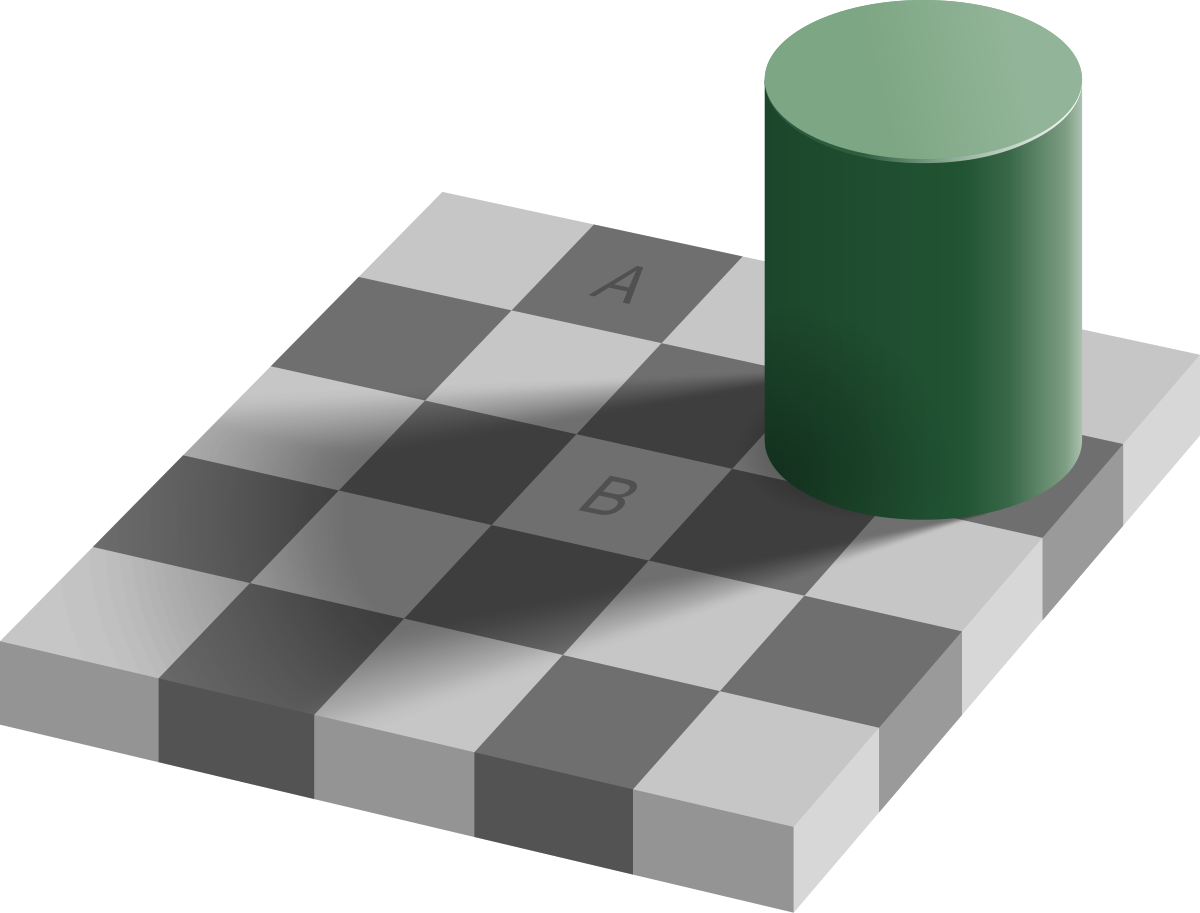
This is the checkerboard illusion. It’s pretty famous, you’ve almost certainly seen it before, but for the moment pretend that you haven’t. Now, suppose we have an individual named Charlie. Charlie hates a particular shade of grey, such that whenever he sees it, he says things like “What an ugly color!” thinks to himself “That’s gross” and so on. Let us call the shade of grey that produces this experience in Charlie the ‘C shade’ of grey. Suppose further that the C shade of grey is a lighter shade than the A square appears to be in this image. Given this, when Charlie looks at the checkerboard illusion, he says that B is a very ugly color, it produces feelings of disgust in him, and so on. He takes himself to be having an experience of C shade grey when looking at B.
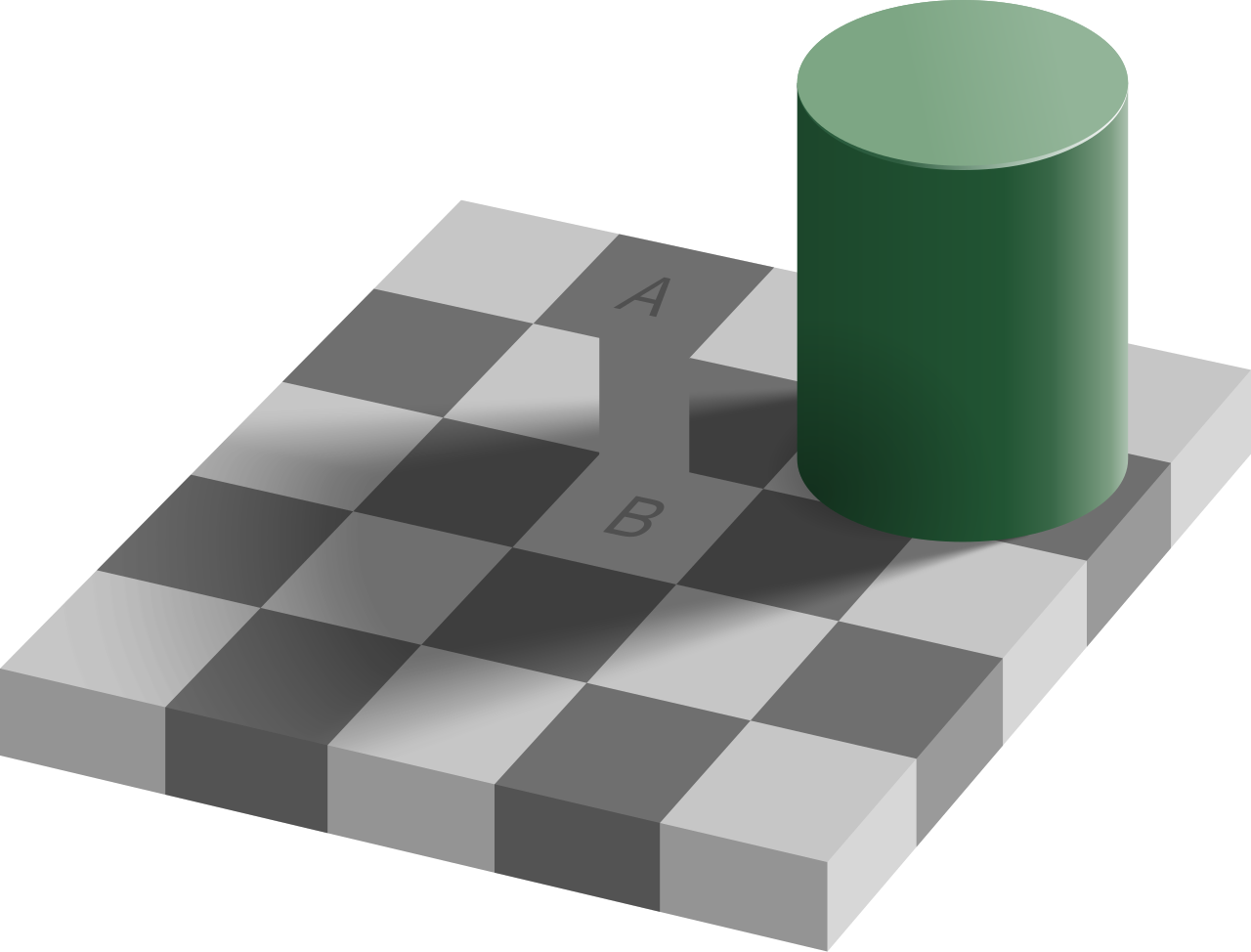
Importantly, A and B are actually the same color. So Charlie is wrong that he sees the C shade only when looking at B (maybe he sees it in both A and B, or neither, but he cannot see it in one and not the other). Despite this, his experience of the illusory coloration of the B square fulfilled essentially the same functional profile (with respect to his verbal reports and responses) as a sample of C shade grey would (even though he was not experiencing C shade grey as is hopefully obvious by the corrected image). Now, this is not a perfect example. I have not stipulated that all the physical goings-on in Charlies brain with respect to the inputs and outputs of the B square color and C shade grey are the same. But this is roughly how I would see a functional analogue of pain working. Returning to niap then, much like Charlie’s illusory experience of the B square’s color, when someone is in the niap state they respond in a much similar way as one would if they were actually in pain, although they are not literally in pain.
So, we have our analysis. The reason there is felt contingency in the heat and motion of molecules case (on this view) is not strictly due to qualitative properties, but rather the possible variation in the things that fulfill the functional role at issue. Importantly the qualitative properties are subsumed under the functional role of heat in this analysis, they are part of what contributes to the felt contingency but are not the ultimate explanation of it. We can then, as I argue above, extend this analysis to the case of pain = C fiber firings. If we do so, we meet Kripke’s challenge, thus obviating the issue.
Two quick worries
One problem with the above is that I haven’t really given you a reason to think this is the correct analysis of the felt contingency here. Thankfully, I don’t think Kripke gives you a great reason to think his analysis is correct either, he sort of just wins by default given the apparent lack of alternative options. I’m fine to leave that as the status of the dialectic for now (to be honest, which of these is the ‘correct’ analysis of the felt contingency seems like it will turn out to be an empirical matter so I’m not even sure I could provide positive or negative arguments to that effect).
You might also worry that this explanation relies on the falsity of functionalism. If something could be a functional duplicate of pain, and yet not be pain, then isn’t functionalism false? Firstly, there are views which to my mind are sort of hybrid between functionalism and type theory (see David Lewis) and it isn’t clear to me that they rely on this being true. Regardless of that though, I think my diagnosis works even if you just stipulate that the new sate is a functional analogue of the thing in question, i.e. niap need not be a functional twin of pain, it must only fulfill a wide range of pain’s functional roles to explain the felt contingency.
I actually consider this, still, a bit of an oversimplification. There are a range of views of how to *do* type physicalism (for instance, I consider Lewis a type physicalist, he’s just a functional specification theorist which was a later evolution of the view than the early type theorists like JJC Smart.) I don’t think the particulars of this matter a ton for our purposes, though I think some ways of doing type physicalism will be more or less friendly to what I say here. For the moment that goes beyond the scope of my ambition to explore, though.
It is worth noting that this is the inverse of the way I did this example before. We are now looking at a case where we have something that does produce the heat feeling but is not heat, whereas before I highlighted a case where proper heat does not produce the heat feeling. To get the desired result you want your explanation to be able to accommodate both such cases, I think both of these solutions can do so for the heat identity, I just elected to do the opposite cases across the two solutions for the sake of brevity.
One thing that kind of supports this analysis, or maybe it would be more accurate to say it supports the analysis that both heat and pain just are whatever fulfills the functional roles assigned to them (which kind of makes the felt contingency go away) is that heat isn’t actually defined as the motion of molecules. The motion of molecules just happens to be the way that thermal energy is stored in most everyday thermodynamic systems (especially in ideal gases, where the temperature is proportional to the average kinetic energy of gas molecules).
The true definition of hotness (I use this term instead of heat because in physics, the word “heat” is actually used to refer to energy transfer between systems, not to how hot a system is) is based on its functional role - namely, the fact that heat always flows from a hotter system to a colder one. Hotness is usually quantified by temperature, which is defined as 1/beta, with beta being the derivative of a system’s entropy with respect to internal energy, holding volume and particle number fixed. It follows from the second law of thermodynamics that when two systems are put into thermal contact, heat will flow from the system with lower beta to higher beta, making beta a measure of coldness, so for positive values of beta, its reciprocal is a measure of hotness.
So the true definition of hotness is not “how much the molecules are moving,” but something much more abstract, and the reason for that abstract definition is that it satisfies the functional role “hotness” is meant to describe. So it makes a lot of sense that the felt contingency of identities comes from imagining situations where the same thing serves a different functional role, given that this is how we determine the identity of something in the first place.
Kripke's argument against physicalism has always struck me as offering a pretty devastating reductio against his own theory of reference. If his theory of reference makes that argument a good one, then his theory of reference is clearly a bad theory.